
News
Behind the Headlines
Two-Cents Worth
Video of the Week
News Blurbs
Articles
Testimony
Bible Questions
Internet Articles (2015)
Internet Articles (2014)
Internet
Articles (2013)
Internet Articles (2012)
Internet Articles (2011)
Internet Articles (2010)
Internet Articles
(2009)
Internet Articles (2008)
Internet Articles (2007)
Internet Articles (2006)
Internet Articles (2005)
Internet Articles (2004)
Internet Articles (2003)
Internet Articles (2002)
Internet Articles (2001)




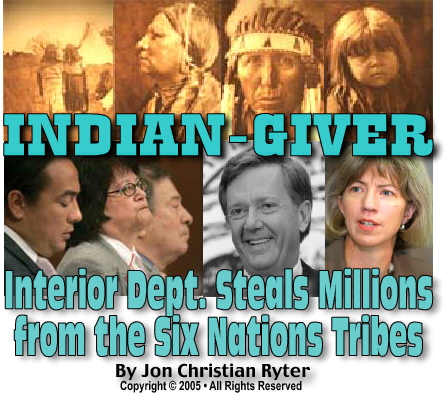
 n
the 9-year legal battle over missing Blackfoot Indian royalties,
US District Court Judge Royce Lamberth has been a perennial
thorn in the side to the Justice and Interior Departments of both
Bill Clinton and George W. Bush. The case, filed
in Lamberth's court in 1996 is being fought over $137 billion
in missing oil, timber, and grazing royalties and other lease
payments due, not to the tribes but individually, to the Native
American members of what is generically referred to as the Six
Nations (now viewed as a composite of all of the known Indian
tribes) on over 54 million acres of land.
n
the 9-year legal battle over missing Blackfoot Indian royalties,
US District Court Judge Royce Lamberth has been a perennial
thorn in the side to the Justice and Interior Departments of both
Bill Clinton and George W. Bush. The case, filed
in Lamberth's court in 1996 is being fought over $137 billion
in missing oil, timber, and grazing royalties and other lease
payments due, not to the tribes but individually, to the Native
American members of what is generically referred to as the Six
Nations (now viewed as a composite of all of the known Indian
tribes) on over 54 million acres of land.
 When
Lamberth—a colorful and very popular Washington, DC
US District Court judge—determined in a July ruling that
the failure of the Interior Department over several decades to
accurately account for billions of dollars owed to the Indian
tribes in the American Northwest was the epitome of incompetence
by apathetic bureaucrats whose job it was to accurately tally
the money owed to the Six Nations and to make timely and honest
royalty payments to those who owned the land and were legally
entitled to the proceeds from the royalties.
When
Lamberth—a colorful and very popular Washington, DC
US District Court judge—determined in a July ruling that
the failure of the Interior Department over several decades to
accurately account for billions of dollars owed to the Indian
tribes in the American Northwest was the epitome of incompetence
by apathetic bureaucrats whose job it was to accurately tally
the money owed to the Six Nations and to make timely and honest
royalty payments to those who owned the land and were legally
entitled to the proceeds from the royalties.
.jpg) The
lawsuit was originally filed in 1996 by a Blackfoot tribal leader,
Elouise Cobell, as Cobell v Babbitt when her action
was initially filed against the Clinton Interior Department
and its Secretary, Bruce Babbitt. Cobell, 59, a
Blackfoot banker from Montana filed the class action lawsuit based
on the terms of the Dawes Act of 1887. Under the Dawes
Act, the federal government initiated the practice of giving
land allocations to the individual Indians as their reservations
were reassumed by the government.
The
lawsuit was originally filed in 1996 by a Blackfoot tribal leader,
Elouise Cobell, as Cobell v Babbitt when her action
was initially filed against the Clinton Interior Department
and its Secretary, Bruce Babbitt. Cobell, 59, a
Blackfoot banker from Montana filed the class action lawsuit based
on the terms of the Dawes Act of 1887. Under the Dawes
Act, the federal government initiated the practice of giving
land allocations to the individual Indians as their reservations
were reassumed by the government.
Each reservation-dweller Native American family was given a tract. The balance of the former reservations were either retained by the government or sold to land developers, mining companies, or oil drillers and refiners after vast reservoirs of natural resources were discovered beneath the northern plains early in this century.
Today,
one Administration and a decade later, the 1996 lawsuit has been
amended as Cobell v Norton. Even under the "compassionate"
president, George W. Bush, the US government is not any
closer to reaching a settlement. Unfortunately, the "accounting"
of Indian wealth on-and-under the land given to the people of
the Six Nations by "Karanduawn," the "Great White
Father in Washington" has gotten worse. The government, according
to Deputy Interior Secretary J. Steven Griles, is clueless
how much—if any money—is owed to the Blackfoot and other
Indian tribes.  "Nobody
has shown me that there is a loss," Griles said.
"They haven't provided one shred of evidence [that the government
owes them anything]."
"Nobody
has shown me that there is a loss," Griles said.
"They haven't provided one shred of evidence [that the government
owes them anything]."
Let
me provide the Deputy Secretary with one example that at least
suggests maybe the Interior Department should use something other
than tongue-in-cheek invisible ink when they compute oil royalties
since the US government has been systematically cheating the Six
Nations since 1900 by paying royalties based on the price of oil
at the wellhead at the turn of the last century. .jpg) Eighty
year old Navajo grandmother Mary Johnson has four oil wells
on her farm that have been pumping oil steadily, around the clock,
for about 50 years. According to Johnson, the oil wells
have polluted all of the creeks running through her land. The
stench of crude fouls the air she breathes and has sickened her
livestock. Each month, just like clockwork, Johnson receives
a royalty check from the US Bureau of Indian Affairs. How much
is the check now that crude oil is selling for $68 per barrel?
The checks have never varied. They don't increase with rising
cost of crude. Johnson gets just about enough money to
fill her gas tank once a month—approximately $40. That's
the same amount she received in 1960 when the gasoline that now
sells for about $3 per gallon cost less than 20 cents a gallon—and
crude oil sold for less than $4 per barrel. According to attorney
Alan Balaran, who handled the case for Cobell for five
years until he recently resigned, citing government obstruction,
he uncovered evidence that the oil giants that own the leases
on the land were paying Native Americans significantly less than
they were paying non-Indian for the gas and oil rights on their
land.
Eighty
year old Navajo grandmother Mary Johnson has four oil wells
on her farm that have been pumping oil steadily, around the clock,
for about 50 years. According to Johnson, the oil wells
have polluted all of the creeks running through her land. The
stench of crude fouls the air she breathes and has sickened her
livestock. Each month, just like clockwork, Johnson receives
a royalty check from the US Bureau of Indian Affairs. How much
is the check now that crude oil is selling for $68 per barrel?
The checks have never varied. They don't increase with rising
cost of crude. Johnson gets just about enough money to
fill her gas tank once a month—approximately $40. That's
the same amount she received in 1960 when the gasoline that now
sells for about $3 per gallon cost less than 20 cents a gallon—and
crude oil sold for less than $4 per barrel. According to attorney
Alan Balaran, who handled the case for Cobell for five
years until he recently resigned, citing government obstruction,
he uncovered evidence that the oil giants that own the leases
on the land were paying Native Americans significantly less than
they were paying non-Indian for the gas and oil rights on their
land.
Griles insists there is no evidence that the government owes the 50,000 member Blackfoot tribe—or any other tribe—money. He insisted it is incumbent upon the plaintiffs to prove the allegations that they've been cheated by the federal government. Several independent investigations have found enough evidence to convince Lamberth the action filed by Cobell has merit. Cobell's lawsuit was certified as a class action.
(She also represents close to a half million Cree, Navajo, Cherokee, Piute, Apache, Sioux, Mohawk, Seneca, Iroquois, Seminole, Tuscaroras, Cayagas, Oneidas, Ojibway, Onondagas, Shoshoon, and another dozen or so lesser known Native American tribes seeking $137 billion in damages for "missing" Indian Trust royalties.)
Even though the government initially insisted that its Indian Trust records were up-to-date and in good shape, a review ordered by Lamberth supported Cobell's contention that the Interior Department never kept complete records of lease payments by the oil companies, loggers, and agri-giants that leased vast tracts of farmland. In addition, Lamberth's investigation revealed that unknown amounts of Indian Trust money was simply deposited in the general treasury to help balance the federal budget. And, Lamberth learned, both the Clinton and Bush Administrations let oil and gas companies exploit Indian lands at bargain basement rates for what could be nothing other than quid pro quos.
Judge
Lamberth described the case as the "...gold standard
for mismanagement by the federal government for more than a century."
 In
1999 Lamberth ruled that the government had breached its
fiduciary responsibilities to the trust. In the last hearing,
in August, 2005, Lamberth chastised the federal government
when he said: "On numerous occasions over the last nine
years the Court has wanted to simply wash its hands of Interior
and its iniquities once and for all. But doing so," he
concluded, "would constitute an announcement that negligence
and incompetence in government are beyond judicial remedy."
In point of fact, Lamberth's worst fears have become
fact. Our Constitution, and the liberty we have historically construed
as God-breathed and inherent, is now construed by the government
to be conditional—and based not on the Constitution of the
United States but the UN Declaration of Human Rights whose privileges
of liberty are retractable gratuities.
In
1999 Lamberth ruled that the government had breached its
fiduciary responsibilities to the trust. In the last hearing,
in August, 2005, Lamberth chastised the federal government
when he said: "On numerous occasions over the last nine
years the Court has wanted to simply wash its hands of Interior
and its iniquities once and for all. But doing so," he
concluded, "would constitute an announcement that negligence
and incompetence in government are beyond judicial remedy."
In point of fact, Lamberth's worst fears have become
fact. Our Constitution, and the liberty we have historically construed
as God-breathed and inherent, is now construed by the government
to be conditional—and based not on the Constitution of the
United States but the UN Declaration of Human Rights whose privileges
of liberty are retractable gratuities.
Lamberth ruled in July that the Interior Department's failure over several decades to account for billions of dollars due to Native Americans by the Bureau of Indian Affairs constituted "...outright evil, apathy, cowardice or crushing bureaucratic incompetence..." Lamberth told one Interior Department witness: "You know any banker would be in jail for handling funds like this, don't you?" The government lawyers, who feared the stinging wrath of the judge, cringed and decided that Lamberth had to go if they were ever going to prevail.
On August 15 the Justice Department filed a brief with the US Circuit Court of Appeals for the District of Columbia requesting that Lamberth be removed because he not only used intemperate language towards the government's lawyers, he ignored appellate rulings and accused the government of "...falsification, spite and obstinate litigiousness [with] no legal or factual basis." There was nothing wrong or improper in Lamberth's accusations towards the government's lawyers—particularly since Lamberth was correct. The Justice Department knew that not only was the US government was about to lose the biggest lawsuit in American history, the bureaucrats at the Department of Indian Affairs were going to be branded as thieves of the worst sort—stealing not from the richest, but the poorest, of all Americans.
The appellate court is actually considering the government's request. Clearly, if the Circuit Court of Appeals grants the government's wish, it will erase Cobell's chances of winning her lawsuit since the Justice Department will hand-pick a federal magistrate who will be much more sympathetic to the government's position.
Cobell has devoted most of her life to this issue. She travels between Washington and her home near Glacier National Park in Montana 40 weeks a year. Cobell admits she is not absolutely certain of the total amount owed to Native Americans, but only because she isn't certain precisely how much land the 300 to 500 thousand plaintiffs in her action actually own.
 The
Bush Administration—like the Clinton Administration
before it—tried unsuccessfully to remove Lamberth
from the case, hoping another judge would dismiss the lawsuit.
Sen. John McCain [R-AZ] who chairs the Senate Indian
Affairs Committee decided the only way this case will ever
be resolved is to legislate a solution. In the spring of 2004
McCain asked Cobell what reforms in the Bureau
of Indian Affairs she felt were needed, and what realistic
amount would have to be offered for Cobell to settle the
lawsuit. Cobell responded with 50 items that needed to
be included in McCain's legislation to solve the problems
in the Bureau of Indian Affairs, In addition, she said
the Six Nations would settle for a cash payment of $27.5 billion—that
was exempted from any taxes. The amount, she argued, was far less
than the government actually owed the Indian Nations.
The
Bush Administration—like the Clinton Administration
before it—tried unsuccessfully to remove Lamberth
from the case, hoping another judge would dismiss the lawsuit.
Sen. John McCain [R-AZ] who chairs the Senate Indian
Affairs Committee decided the only way this case will ever
be resolved is to legislate a solution. In the spring of 2004
McCain asked Cobell what reforms in the Bureau
of Indian Affairs she felt were needed, and what realistic
amount would have to be offered for Cobell to settle the
lawsuit. Cobell responded with 50 items that needed to
be included in McCain's legislation to solve the problems
in the Bureau of Indian Affairs, In addition, she said
the Six Nations would settle for a cash payment of $27.5 billion—that
was exempted from any taxes. The amount, she argued, was far less
than the government actually owed the Indian Nations.
Cobell
told McCain that Congress would have to appropriate new
funds (not money from the Indian Tribe funds) to settle the claim
since she knew if the "source" of the payment was not
specified in the legislation, the government would simply shift
funds from some other Indian relief program. 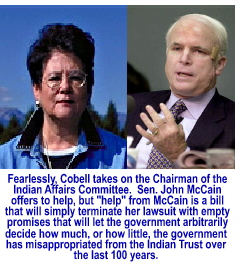 Cobell
also asked that a new Deputy Secretary of the Interior be appointed—a
Native American—who would have complete oversight of the
agencies that manage the Indian Trust.
Cobell
also asked that a new Deputy Secretary of the Interior be appointed—a
Native American—who would have complete oversight of the
agencies that manage the Indian Trust.
McCain balked at all of her recommendations. The $27.5 billion, he said, was "...just way out of sight," adding that Congress would not appropriate "new money" to settle an old debt. The legislation, he said, would be the place where negotiations began. McCain introduced a bill which he called "...a starting point," knowing if the bill was passed and signed into law, it would become the final resting place of the Indian Trust claims. The bill does not mention any dollar amount that was construed to be "owed" to the Six Nations.
The plaintiffs in Cobell v Norton reacted angrily when they realized that the Chairman of the Indian Affairs Committee was not interested in resolving the lawsuit, only ending it. Cobell, in an interview with the Rapid City, SD Journal compared the McCain bill to the infamous Baker Massacre (considered to be the worst slaughter of unarmed American Indians by US troops). The comparison to the Baker Massacre brought the famous McCain temper to a boil as he defended his legislation in an Indian Affairs Committee meeting where he said the bill "...reflects extensive listening to the parties in the litigation, and it cannot credibly be compared to a massacre even in a figure of speech." McCain then advised the plaintiffs in Cobell v Norton to grab the chance to sit down with lawmakers and negotiate. "Leave the rhetoric to others," he advised Cobell. "You won't have this opportunity again anytime soon." (My observations of "government in action" is that anytime American citizens are willing to surrender their rights, government always has an outstretched hand.)
McCain's legislation would provide for a lump sum payment of whatever amount was deemed by the "appropriate authority" to be owed to the plaintiffs through a settlement fund administered by the US Treasury. One basic remains unanswered. How much money has the US government earned from leasing Indian land? No one knows. But it is likely in the hundreds of billions over the last 118 years.
Ultimately what happened was the appointment of two mediators— approved by both sides—to attempt to iron out differences and arrive at a compromise that will work for both parties.
I guess it can honestly be said that the most heavily taxes Americans are Native Americans. It can also honestly be said that the American Indian has been taxed into poverty. You might also say that Sen. John McCain was Gen. George Custer's revenge on the Six Nations for the Little Big Horn.

Copyright © 2009 Jon Christian Ryter.
All rights reserved.