News
Behind the Headlines
Two-Cents Worth
Video of the Week
News Blurbs
Articles
Testimony
Bible Questions
Internet Articles (2015)
Internet Articles (2014)
Internet
Articles (2013)
Internet Articles (2012)
Internet Articles (2011)
Internet Articles (2010)
Internet Articles
(2009)
Internet Articles (2008)
Internet Articles (2007)
Internet Articles (2006)
Internet Articles (2005)
Internet Articles (2004)
Internet Articles (2003)
Internet Articles (2002)
Internet Articles (2001)



 hen
the American government announced they were modifying the United States
currency for the second time since 1996 they argued, with a handful
of Federal Reserve statistics that were ostensibly designed to prove
their point, that it is now necessary to make the American dollar look
more like the currencies of our neighbors in Central and South America
in order to make it harder for the bad guys to counterfeit it.
hen
the American government announced they were modifying the United States
currency for the second time since 1996 they argued, with a handful
of Federal Reserve statistics that were ostensibly designed to prove
their point, that it is now necessary to make the American dollar look
more like the currencies of our neighbors in Central and South America
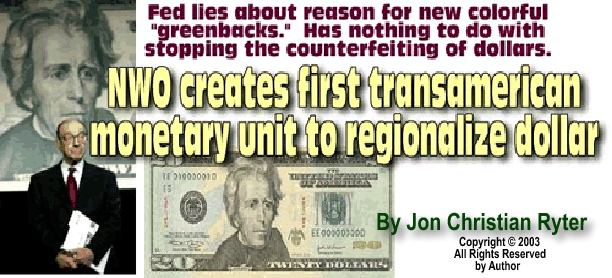
in order to make it harder for the bad guys to counterfeit it.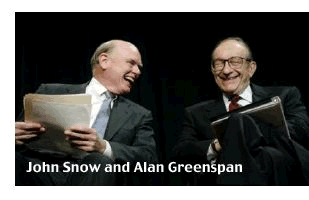 But this time around you don’t need a Zogby poll to understand
that Fed Chairman Alan Greenspan, Treasury Secretary John Snow, and
the Bush “43” White House are lying to the American people
about the reason why America’s currency is getting its second face
lift in less than a decade. Tragically, only the hard-core conspiracy
politics Fed watchers or the equally conspiratorial anti-UN crowd who
are watching the evolution of world government, even noticed. The rest
of us are anxiously waiting for the first appearance of America’s
new Technicolor dollars because we’ve been told they will be prettier
than what we now have.
But this time around you don’t need a Zogby poll to understand
that Fed Chairman Alan Greenspan, Treasury Secretary John Snow, and
the Bush “43” White House are lying to the American people
about the reason why America’s currency is getting its second face
lift in less than a decade. Tragically, only the hard-core conspiracy
politics Fed watchers or the equally conspiratorial anti-UN crowd who
are watching the evolution of world government, even noticed. The rest
of us are anxiously waiting for the first appearance of America’s
new Technicolor dollars because we’ve been told they will be prettier
than what we now have.
Too few of us pay enough attention to
the currency in our pockets. We need to be much more attentive because,
throughout the history of the United States, whenever Uncle Sam decides
to revamp the U.S. dollar to ostensibly save the American people some
unknown and previously unanticipated economic grief, it ends up costing
the American taxpayers a lot more than the rhetoric that accompanied
the redesign suggested it was going to save. But then, logic tells us
that when a thief comes in the dark of night, he will never shine a
light on his arrival, nor will he reveal what it is he intends to steal.
The theft itself is seldom discovered until its too late to prevent
the loss.
In 1933, just minutes before Franklin
D. Roosevelt’s New Deal Congress passed the Emergency Banking Relief
Act of March 9, 1933 (in less than one day without even taking the time
to read the bill that legalized the rape of the wealth of the American
people before the bill became law), the American $20 bill looked like
the greenback shown, above, on the left.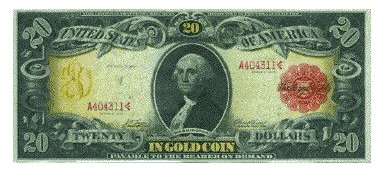
The $20 gold certificate was redeemable
in $20 in gold coins or bullion at any federal bank. Likewise, the silver
certificate was redeemable in silver coin or silver bullion. Coinage,
not currency, was specie. Currency was a certificate of deposit for
the gold or silver contained within the vaults of America’s central
banks or at Fort Knox. When you had silver or gold certificates in your
pocket, you actually owned wealth.
Not any more.
Now, because our currency is printed in
the form of Fed “notes” (notes signify debt, not wealth) rather
than “certificates of deposit,” wealth owns us because our
money is completely fiat. It is scrip. As such, it is worth what the
independent bankers at the Federal Reserve says it is worth. And they
can arbitrarily raise or lower the value of that scrip simply by increasing
or decreasing the amount of fiat in circulation. The central government
of the United States, shockingly, has nothing to say about it. The government
of the United States unconstitutionally relinquished its right to control
the value of its own currency when it enacted the Federal Reserve Act
of 1913 and gave the world’s wealthiest banking and industrialist
families the right to create the nation’s money supply from nothing--and
profit from its creation by loaning it to the American taxpayers who
were obligated to pay them for its use.
Until 1934, the American dollar was still
theoretically backed with gold and silver even though it had become
too elastic due to the Fed issuing too many greenbacks. Even though
the greenback was supported by gold and silver, each greenback in circulation
became worth less money because each dollar can be worth no more than
an equal part of the aggregate value of all of the gold and silver on
deposit in the nation’s central banks that support it. Beyond that,
currency collapses and is worth nothing. 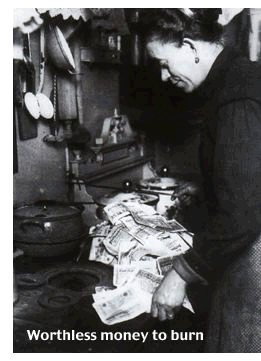 That
was precisely what happened to the German Mark at the end of World War
I when hyperinflation destroyed the Weimar Republic’s economy and
the Reichmark dropped in value so fast that money earned by the German
factory worker was virtually worthless by the time they were paid. In
September, 1923 it took 500 million Reichmarks to equal one American
dollar. In 1918 a pound of potatoes in Germany cost 1/8 Mark. In November,
1923 that same pound of potatoes cost 50 billion marks. One egg cost
1/4 mark in 1918. It cost 80 billion marks in 1923. And a pound of butter
that cost 3 marks in 1918 required a wheelbarrow filled with 6 trillion
marks in November, 1923 to purchase. Kindling wood or coal for the average
German’s cookstove cost far more than the money that bought it
was worth. Many German housewives actually used money for kindling since
it was cheaper to burn money than coal or wood.
That
was precisely what happened to the German Mark at the end of World War
I when hyperinflation destroyed the Weimar Republic’s economy and
the Reichmark dropped in value so fast that money earned by the German
factory worker was virtually worthless by the time they were paid. In
September, 1923 it took 500 million Reichmarks to equal one American
dollar. In 1918 a pound of potatoes in Germany cost 1/8 Mark. In November,
1923 that same pound of potatoes cost 50 billion marks. One egg cost
1/4 mark in 1918. It cost 80 billion marks in 1923. And a pound of butter
that cost 3 marks in 1918 required a wheelbarrow filled with 6 trillion
marks in November, 1923 to purchase. Kindling wood or coal for the average
German’s cookstove cost far more than the money that bought it
was worth. Many German housewives actually used money for kindling since
it was cheaper to burn money than coal or wood.
The Fed bankers created a rule that allowed
them to “elasticize” the dollar by circulating four times
as much currency as there was gold in the nation’s vaults on the
mistaken belief that, at any given time, no more than 25% of the depositors
of any bank would demand their deposits. The elasticity of the American
dollar did not become problematic until the Fed bankers decided they
wanted to remove the dollar from the gold standard (even though a gold-
or silver-backed currency is mandated by the Constitution). Since Congress
learned in 1913 that they would never get enough votes to send a constitutional
resolution to the States, nor would the States likely approve a constitutional
amendment to remove America’s monetary system from the gold standard,
the Fed bankers created a crisis that would allow them to use the 9th
Amendment (the compelling need of the government to take an otherwise
unconstitutional course of action because it was necessitated by a national
emergency that threatened to destroy the nation) to achieve their objective.
In 1922 when the gold certificates were
reprinted, the redemption statement on the new ten dollar certificates
read: “This certifies that there have been deposited in the Treasury
of the United States of America ten dollars in gold coin payable to
the bearer on demand.” Real money was theoretically easy to get.
The bearer need only present a gold certificate at the bank and receive
gold coins equal to the monetary value of the certificate. In 1928 when
the gold drain began, the redemption statement was modified to make
it more difficult for people to exchange their gold certificates for
real gold. The new redemption clause read: “Redeemable in gold
on demand at the United States Treasury or redeemable in gold or lawful
money at any Federal Reserve Bank.”
Now, to get gold for your cash, you had
to take your gold certificates to the Treasury in Washington, DC or
one of the 12-regional Fed banks. In 1933, with the passage of the Emergency
Banking Relief Act, all gold certificates had to be surrendered at a
federal bank and be replaced with a Federal Reserve note in an equal
amount. (Compare $20 gold certificate [top of page] with the top Fed
note [immediately below].) The currency issued by Franklin D. Roosevelt
was no longer redeemable for either gold or silver. The redemption clause
read: “This note is legal tender for all debts, public and private,
and is redeemable in lawful money at the United States Treasury or at
any Federal Reserve Bank.” With the passage of the Congressional
Gold Clause Joint Resolution on June 5, 1933 the Fed bankers stole the
wealth of citizens of the United States--the gold that rightfully belonged
to those who, on March 9, 1933, owned the gold certificates that they
would be forced, under the threat of a prison sentence and a $10 thousand
fine, to surrender to the Federal Reserve where they would be issued
new money backed with an empty promise.
Today, when you read that clause on the
money in your pocket it says: “This note is legal tender for all
debts, public and private.” It is no longer redeemable for anything.
Note the clause on the top $20 Federal Reserve notes (to the left).
When the Federal Reserve notes were modified
in 1996 with the redesign of the $100 and $50 bills, the government
argued that counterfeiting by Iraq and other Muslim nations necessitated
the move. The government argued that those nations were counterfeiting
$100 bills faster than the US Mint could print them. There’s probably
some truth (but not a lot of it) in that statement.
If you recall, when US forces captured Baghdad
they stumbled upon a cache of one billion dollars hidden in a sealed
warehouse. Nine hundred million was in US $100 bills and the balance
was in Euros. Military intelligence learned that another ten billion
in American dollars--stacked on pallets had been loaded on three tractor
trailers that were transported to Iran one day before the Iraqi War
began. No one is sure yet if that money is genuine or bogus. More likely
than not, it will prove to be counterfeit.
What is even more interesting now is that,
even with what could be several billion in bogus bucks floating around
the Mideast, the Treasury Department has \decided that the biggest foreign
counterfeiters are not Iraq, Iran or Syria--who supposedly created the
almost perfect $100 bills that necessitated the remodeling of our currency--but
Columbia, in Central America.
Theoretically,
when the US currency was modified in 1996, it was supposed to be counterfeit-proof.
At least, that’s what the American people were told. On the new
bills were space-age holograms and high tech watermarks. The security
threads woven into the 25% linen, 75% cotton paper were chemically-treated
so that when they are exposed to ultra-violet light they will glow.
What is most interesting is that the threads on different denominations
glow in different colors. When held at slight angles, the green ink
on the $10 bill appears black.There is fine line printing within the
portraits that appears, to the eye, to be merely lines. Of course, in
my mind, if a banknote is counterfeit-proof, that means the average
shopkeeper should be able to spot a bogus bill. However, your neighborhood
7-Eleven, Safeway or Wal-Mart doesn’t come equipped with ultraviolet
lights to see if the red and blue threads in the new bills glow in the
right color. Nor do they have microscopes at the checkouts to examine
the lines within the presidential portraits to see if they really are
lines or if they’re cleverly devised printing that only appears
to be lines. So, as nifty as all these space-age anti-counterfeiting
devises are, not even the teller at your local bank can tell if the
new bills they receive in their daily transactions with the local business
community are genuine or bogus--unless the counterfeiter is really sloppy
and bought his currency paper at K-Mart or is having his bogus bills
printed at Kinkos or Sir Speedy. Most counterfeit banknotes are not
detected until they are recycled back through the Fed. In the meantime,
hundreds of people may have handled the bogus bill as it circulated
throughout the community as legal tender for several months before ending
up in the burn pile at the Fed.
On March 14, 2003, the Treasury and the
Federal Reserve told Congress that counterfeiting in the United States
had declined sharply since the new security features were incorporated
in the US bills in 1996. The Treasury report noted that in 2002 there
were only 35 counterfeit bills found per one million bank notes examined
at the Fed. Prior to the redesign, the Treasury found an average of
200 counterfeit bills per one million bank notes processed.
While there is no yardstick from which
to accurately gauge it, the US government conservatively estimates that
there is over $300 million in bogus American dollars in circulation
around the globe. Over the past five years, various law enforcement
agencies around the world seized over $665.7 million in counterfeit
American money in Central and South America and in Europe and Asia--none
of which came from Iraq, Iran or Syria (who were listed in 1996 as the
leading counterfeiting nations since the CIA was convinced the terrorist
nations were financing global terrorism with counterfeit American dollars).
Now the US Treasury claims that Columbia
is the leading counterfeiter of American currency in the world. This
determination reputedly comes from forensic chemists who, the Treasury
Department says, study captured counterfeit bills to ascertain (among
other things) the type of trees the paper came from, and the elements
in the inks that helps pinpoint precisely from where the materials came
and in which countries the bills were most likely printed. The Secret
Service (which functions as the police agency for the Treasury) seized
$86 million in counterfeit US banknotes in Columbia last year. In one
sting operation, American Secret Service agents working with the Columbian
government found a 12’ X 15’ underground printing plant in
the middle of a banana plantation. A Treasury spokesman said that after
matching some of the banknotes found in that plant with some of counterfeit
bills in the possession of the Treasury Department, forensic scientists
determined that single printing plant had produced over $20 million
in counterfeit bills over the past decade.
The Secret Service, which has three agents
working out of the US Embassy in Columbia, zeroed in on that country
because, according to a Treasury spokesperson, Columbia has the printing
expertise and the artisans needed to create near perfect counterfeit
money. Further, they argue, Columbia prints the legitimate currency
for several countries. Therefore, they conclude, not only does Columbia
possess the knowledge and ability to create perfect monetary clones,
they also have the necessary printing equipment--which the Secret Service
noted, does not come cheaply. Further, because Columbia is the number
one producer of cocaine in the world, and 90% of the cocaine found in
the cities of America originated there, the CIA believes Columbia is
using its advanced drug delivery network to smuggle counterfeit money
into the United States.
The government’s reasoning appears
to have come right out of a dime novel. The dialecticism is so full
of holes that not even an extremely large beach umbrella could catch
the faulty thinking. While Uncle Sam’s argument may sound logical
to a good portion of the American people on the surface, it is so flawed
that it’s difficult to imagine that our government would attempt
to palm it off on the American people as the truth --or that they could
keep a straight face as they did it I guess that’s why John Snow
and Alan Greenspan were laughing in this photo op when the new multicolored
dollar was announced. But then, why not? Half of America still believes
the adage, “I’m from the government...and I’m here to
help you.”
Government spinmeisters spun the logic
that Columbia is the new counterfeiting kingdom of the world because
they have the expert craftsmen who produce the currencies for several
other countries. This implies that otherwise 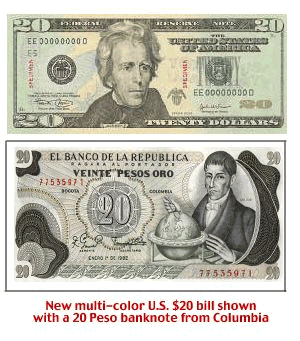 honest
artisans moonlight as counterfeiters, or that currency designers automatically
become counterfeiters if they lose their jobs with the government printing
agencies. Counterfeiters are criminals who employ equally dishonest
artisans to create the plates for the currencies they plan to duplicate.
So it makes no difference how many “expert craftsmen” are
employed by those governments since it is generally not those artisans
who create the bogus bills. Second, the Treasury’s public relations
spinmeister suggested that since Columbia has the necessary printing
equipment--which is very expensive--that Columbia is even more suspect.
That statement has merit only if the Treasury is suggesting that the
Columbian government is counterfeiting US currency, and of course, there
is no evidence that they are. Also implied is the suggestion that if
the Columbian government can afford high tech currency printing presses
any neighborhood drug dealer in Columbia can do the same. Or, it may
be that our government is implying that Columbian government presses
work double time and that government workers are covertly printing counterfeit
US currency after hours. And, of course, there is no evidence that they
are doing that either. If they were, logic further suggests that the
last thing in the world the US Treasury would then want to do then was
add a lot of color to the backgrounds of the American greenbacks because
that would only make it easier for Columbian artisans to duplicate it
since the currencies of every other nation in the world contain splashes
of color that theoretically stymie the counterfeiters in those nations.
Based on the penalties incurred if you were caught counterfeiting, Columbia
may well have been a haven for counterfeiters until December of last
year. Columbia had very lax laws dealing the penalties forgers suffered
when caught counterfeiting foreign currencies. Many times the sentences
amounted to not much more than a slap on the wrist. However, pressure
from the World Bank and the International Monetary Fund changed that.
So, while there may have been merit in the Fed’s arguments about
Columbia being a haven for counterfeiters in 1996, that argument doesn’t
hold too much water today.
honest
artisans moonlight as counterfeiters, or that currency designers automatically
become counterfeiters if they lose their jobs with the government printing
agencies. Counterfeiters are criminals who employ equally dishonest
artisans to create the plates for the currencies they plan to duplicate.
So it makes no difference how many “expert craftsmen” are
employed by those governments since it is generally not those artisans
who create the bogus bills. Second, the Treasury’s public relations
spinmeister suggested that since Columbia has the necessary printing
equipment--which is very expensive--that Columbia is even more suspect.
That statement has merit only if the Treasury is suggesting that the
Columbian government is counterfeiting US currency, and of course, there
is no evidence that they are. Also implied is the suggestion that if
the Columbian government can afford high tech currency printing presses
any neighborhood drug dealer in Columbia can do the same. Or, it may
be that our government is implying that Columbian government presses
work double time and that government workers are covertly printing counterfeit
US currency after hours. And, of course, there is no evidence that they
are doing that either. If they were, logic further suggests that the
last thing in the world the US Treasury would then want to do then was
add a lot of color to the backgrounds of the American greenbacks because
that would only make it easier for Columbian artisans to duplicate it
since the currencies of every other nation in the world contain splashes
of color that theoretically stymie the counterfeiters in those nations.
Based on the penalties incurred if you were caught counterfeiting, Columbia
may well have been a haven for counterfeiters until December of last
year. Columbia had very lax laws dealing the penalties forgers suffered
when caught counterfeiting foreign currencies. Many times the sentences
amounted to not much more than a slap on the wrist. However, pressure
from the World Bank and the International Monetary Fund changed that.
So, while there may have been merit in the Fed’s arguments about
Columbia being a haven for counterfeiters in 1996, that argument doesn’t
hold too much water today.
In reality, the revamping of the American
currency for the second time since 1996 has little if anything to do
with counterfeiting and everything to do with making the US currency
visually acceptable to our neighbors in the Western Hemisphere who think
of Americans as “hated gringos” and the American dollar as
the gringo greenback.
At the end of World War II the global
bankers and transnational industrialists decided that national politicians
could no longer be trusted to make the right decisions concerning the
economic issues within their borders. Nor could they be trusted to negotiate
reasonable trade agreements with other nations since they always put
their national interests ahead of the international good of the world
community, and since the bankers, businessmen and industrialists had
become transnational, they decided it was in their best interests to
reconfigure the nation-states to best suit their economic requirements.
In the decades immediately following the
war, the bankers, the businessmen, the industrialists and diplomats
divided the world into spheres of political and economic influence with
the transnational businessmen and bankers supporting only those politicians
who viewed the world through the prism of globalism. Over the next five
decades those spheres of influence evolved into much more complex economic
zones. They became the currency zones of the future “regional nations”
as the largely invisible emprey of the money barons and the transnational
captains of industry established the invisible boundaries of the evolutionary
regional economic zones as the first stage of successfully creating
a cohesive world government was initiated. The New World Order, which
rose from the ashes of the Old World Order of the deposed royalty of
Europe was prematurely born with the creation of the failed League of
Nations in 1920, would necessarily remain an undernourished infant until
the threats to civil liberties posed by global communism were conquered--or
adroitly concealed.
Because communism failed as an economic
system, the Marxist utopians were forced to pretend that their political
system failed as well. The staged collapse of world communism occurred
as a “made for TV” event with the fabricated
coupe to overthrow the government of Mikhail Gorbachev on August 18,
1991.
 According
to Gorbachev in his own book, “The August Coup,” (a propaganda
piece to convince the West of the newly acquired benign characteristics
of the Russians) the communist hard-liners, who attempted to overthrow
his presidency of the Soviet Union, took his family captive at their
Dachau on Cape Foros in the Crimea and held them in total isolation
as they attempted to force him to abrogate his presidency. Yet, these
hard-liners, who theoretically would be executed if their plot failed,
never cut his phone lines to Moscow--nor his ability to freely communicate
with his political allies in the Kremlin. Nor did they restrict his
movement in the dachau which, theoretically, allowed Gorbachev to write
a letter to his supporters in Moscow and smuggle it out of Cape Foros.
Further, according to Gorbachev and the international media, the hard-liners
imposed a news blackout all over the Soviet Union to conceal the coup
until Gorbachev and Russian president Boris Yeltsin were deposed and
arrested.
According
to Gorbachev in his own book, “The August Coup,” (a propaganda
piece to convince the West of the newly acquired benign characteristics
of the Russians) the communist hard-liners, who attempted to overthrow
his presidency of the Soviet Union, took his family captive at their
Dachau on Cape Foros in the Crimea and held them in total isolation
as they attempted to force him to abrogate his presidency. Yet, these
hard-liners, who theoretically would be executed if their plot failed,
never cut his phone lines to Moscow--nor his ability to freely communicate
with his political allies in the Kremlin. Nor did they restrict his
movement in the dachau which, theoretically, allowed Gorbachev to write
a letter to his supporters in Moscow and smuggle it out of Cape Foros.
Further, according to Gorbachev and the international media, the hard-liners
imposed a news blackout all over the Soviet Union to conceal the coup
until Gorbachev and Russian president Boris Yeltsin were deposed and
arrested.
How do we know this? Aside from the fact
that Gorbachev makes the statement in his book, CNN, broadcast the “coup”
live all over the world to watch as Yeltsin stood down the hard-liners
in the Kremlin from the gun turret of a Soviet tank. Had there been
an international news blackout, CNN would not have been allowed to broadcast
the coup--live or any other way--for all the world to see. CNN’s
video cameras would be running only if the coup was staged to convince
the world that the Iron Curtain was falling just as the Berlin Wall
fell the following year. Gorbachev returned to Moscow on August 23,
an international hero who was revered far more in the United States
than he was in the Soviet Union. Since the Russian people knew who he
was, they were not deceived by him. But Yeltsin, the former radical
mayor of Moscow, was viewed by the Russia people as a genuine hero.
From a visual perspective, the former
Soviet Union appears to be gone. Its former satellites are once again
independent nations. Economically and politically, the Russian Federation
has taken its place. It was a name change like the League of Nations
to the United Nations. The former Soviet satellites have an autonomy
today they did not possess during the Soviet era, but it is not much
different than the type of autonomy our 50 States possess in dealing
with the federal government of the United States. Buried behind all
of the democratic rhetoric we have heard emanating from Moscow for the
past decade is the same old Marxist philosophy that brought Vladimir
Lenin to power to in 1917.
The world began to change quickly after
the “fall” of the Iron Curtain. One of the first official
acts of the Clinton Administration was to ram the North American Free
Trade Agreement through Congress. The Europeans suddenly decided to
“fast track” the European Union, merging the nation-states
on the continent into a super nation that could rival the economic might
of America as the economy in England weakened due to their “job
transfer program” to bring the weaker European economies into the
Euro fold.
In the United States, NAFTA was spun as
a “Jobs for America” bill when everyone on Capitol Hill and
in the White House knew that NAFTA would drain up to 18,000 jobs a month
from America. But everyone thought the American economy could absorb
the loss. What the globalists were doing in Europe--creating a super
economic zone--was also scheduled to take place in the Americas in 2000.
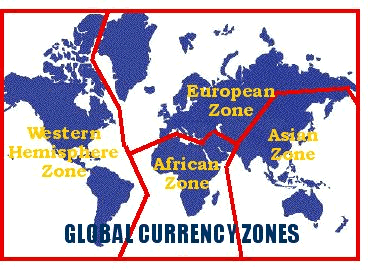
The regionalization of the world’s economies into four (or possibly
five) trade zones that would come complete with their own supra governments
and their own unique currency, much like the Euro followed the merging
of the nation-states of Europe into the European Union is now scheduled
to commence shortly after the Election of 2004 and be complete no later
than 2007 or 2008--with the final merging of the world’s four or
five regional currencies into a single monetary by 2010, or no later
than 2012.
The initial stages of the regionalization
of the currencies--and the economies--of the western hemisphere was
supposed to commence in February, 2002 with a Western Hemisphere Free
Trade Agreement conference at a deliberately undisclosed location in
Northern Canada. However, due to the vociferous and at times violent
protest from anti-global economy protesters, the conference was delayed.
Afraid that organized labor, the communists who had funded the anti-World
Trade Organization protests, and the environmentalists who felt deceived
by the transnational corporations and industrialists who had been funding
their anti-fossil fuel, global warming ecoalarmist message, would find
out where the conference was being held and disrupt it, the conference
was abruptly canceled.
Instead, President George W. Bush met
privately with several of the key players in the Western Hemisphere
over a period of several months. On top of that, the World Bank, the
International Monetary Fund and the Import-Export Bank has, very subtlety,
been applying pressure on the countries in the Western Hemisphere to
dollarize their economies or risk the loss of trade with the United
States. Those who have agreed to dollarize their economies have found
the gates to the American consumers opened wide to them. Those who resist
the gringo greenback found the doors to America’s supermarkets
and stores are closed.
Brazil and Argentina, more than their
smaller less affluent neighbors, are resisting dollarization just as
England initially resisted the Euro because the British did not want
to surrender their monetary sovereignty to the Hague. But due to the
strength of the German economy, England was not strong enough to dominate
the European debate. In the Western Hemisphere, neither Canada nor Mexico
has an economic infrastructure that is strong enough to compete with
the United States. Both nations know they have no choice but to sit
quietly in the back seat as America drives the economic debate. Both
Mexico and Canada realize they will have to dollarize their currencies
if they intend to survive economically in the Western Hemisphere. In
a show of pure bravado, Canada initially demanded a seat on the US Federal
Reserve as a condition of Canadian participation. That demand waned
as America’s global-minded transnational corporations sent even
more US jobs north of the border thanks to NAFTA’s provisions that
allow them to bring cheaply manufactured American-branded Canadian,
Mexican and Chinese goods back into the United States without tariffs.
This will further erode America’s industrial base and destroy even
more jobs in the United States for the sake of global unity.
Once a nation surrenders control of its
currency it has surrendered its financial independence and its external
sovereignty to the bankers and industrialists who control the valuation
of their money. Brazil and Argentina chose to resist efforts to force
them into a European Union-style economic-political alliance with the
United States in which a Congress of the Americas (theoretically controlled
by the United States, Canada and Mexico) would assume supra authority
over all regional economic and political issues in the Western Hemisphere,
and a Court of the Americas that would assume supra judicial authority
over all hemispheric legal issues within the Western Hemisphere--including
all civil liberties issues. Because they resisted surrendering control
over their own internal currency, their economies tanked. America stopped
importing Argentine and Brazilian goods. The World Bank pressured both
nations to pay up their delinquent loans. Both nations found their old
loans being called in, and lines of credit cut off all over the world
as their bond ratings caved.
Thus far, 18 European nations have merged
their economies. When they did, they surrendered their external sovereignty
to the European Union governing body. England joined the EU on a provisional
basis. While the British, Irish and Scots accept the Euro as legal tender,
England was not ready to abandon the pound sterling as England’s
official currency because when the pounds goes, so does British sovereignty--and
the members of the British House of Commons want to get re-elected (just
like the members of the US Senate and House of Representatives want
to get reelected so they will leave the regionalization of the American
dollar to the White House, the Fed and the World Bank). Nevertheless
the Brits, who have the strongest economy in Europe (and who plays a
key role in the EU hierarchy), are still not a full-fledged member of
the European Union since they retain the pound sterling as legal tender
as they trade in Euros. It is important to note that even though England
has not yet replaced the pound sterling with the Euro (and may never
do so “officially”), from a political perspective it has completely
submitted itself to the EU governing body. The British legal system
recognizes European Union law as superior to English law pretty much
the same way Americans accept federal law as superior to State law even
though the contemplation is completely contrary to the tenets of the
Constitution where the States are superior to its central government
(which was created as an agent of the collective States).
The national currencies of the original
12 EU members expired on February 17, 2002 (even though the initial
plans did not call for the complete euroization of the member nations
until July, 2004). By February 1, 2002 six additional nations joined
the original dozen. Several other nations, including Turkey, have applied
for admission.
As the nations of the European Union surrendered
their financial sovereignty to the international banking community,
the United States planned to meet with the heads of all the nation-states
in the Western Hemisphere at an undisclosed location in northern Canada
to finalize plans to implement the Western Hemisphere Free Trade Agreement
(which was supposed to replace the North American Free Trade Agreement
[NAFTA] this year).
Following euroization and dollarization,
which will reduce some 50-odd currencies into two, the nations on the
African continent and those in Asia will merge their currencies by 2004.
All that remains unclear today is whether Australia, New Zealand and
the southern tier Pacific Island tier will produce a 5th regional currency
or if the island nations clustered around Australia will join either
the Asian or African monetary alliance. In any event, by July 1, 2004
185 different national currencies will be reduced to four or five regional
monetary systems.
When that happens, world government with a single global monetary unit—very
likely a cyberunit that exists only electronically—will occur.
World government will be a reality by the end of this decade if not
before.

Copyright © 2009 Jon Christian Ryter.
All rights reserved.