
News
Behind the Headlines
Two-Cents Worth
Video of the Week
News Blurbs
Articles
Testimony
Bible Questions
Internet Articles (2015)
Internet Articles (2014)
Internet
Articles (2013)
Internet Articles (2012)
Internet Articles (2011)
Internet Articles (2010)
Internet Articles
(2009)
Internet Articles (2008)
Internet Articles (2007)
Internet Articles (2006)
Internet Articles (2005)
Internet Articles (2004)
Internet Articles (2003)
Internet Articles (2002)
Internet Articles (2001)




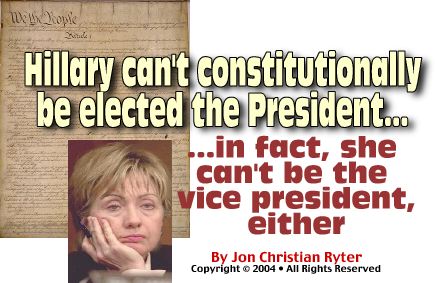
 ven before his term of office expired at noon on January 20, 2001, President William Jefferson Clinton was quietly querying friendly members of the U.S. Supreme Court to see if they would be inclined to rule that the 25th Amendment prevented a president from serving more than two terms in the White House, or if there might be five justices on the high court who could be legally persuaded that the 25th Amendment didn't exclude the president from serving more than two terms, only that it prevented him from serving more than two consecutive terms. If the Justices could be convinced to frame a ruling based on what Clinton believed was "the spirit" in which the 25th Amendment was offered for ratification rather than the high court adhering to the letter of the language within the amendment, Clinton might have been able to return to the presidential political arena in 2004 and challenge the son of his old nemesis. However, the consensus Clinton sought from the justices of the high court escaped him. It was the view of the US Supreme Court that the 25th Amendment was clear and unambiguous. No man could hold the office of President for more than two terms. And, any president serving two years and one day of the unexpired term of a former president was ineligible to seek re-election at all.
There has been some idle chatter in Democratic circles of Kerry offering the vice presidential slot on the Democratic ticket to Bill Clinton—even though Hillary tried hard to buy it for herself. However, the 25th Amendment prevents Bill Clinton from being placed on the ticket as Kerry's vice presidential running mate just as Article II of the Constitution prevents Hillary Clinton from constitutionally assuming for the job. In fact, for precisely the same reason that Bill Clinton can't serve as vice president, neither can Hillary. Why? Because she cannot constitutionally fill the vacancy caused by the death, resignation, impeachment and removal of any US president under whom she served. The Constitution of the United States actually prevents Hillary—or any woman for that matter—from ascending to the office of President even though several women have already run for the office.
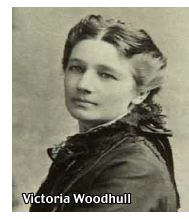 The first woman to run for President of the United States was Victoria Woodhull, a stockbroker and "protégé" of railroad tycoon Cornelius Vanderbilt. Woodhull ran for President on the Equal Rights Party ticket in 1872. Belva Lockwood, the first woman admitted to practice law before the US Supreme Court became that party's candidate for president in 1884 and 1888. Both women ran on a platform for which there was no constituency that would vote for them—not even themselves. Neither woman could vote. Nor, for that matter, could any other woman in America until the ratification of the 19th Amendment on Aug. 18, 1920. While the 19th Amendment provided women with the right to vote, it did not provide them the right to seek the highest office in the land—a legality that has been overlooked by office seekers, male and female, since 1920.
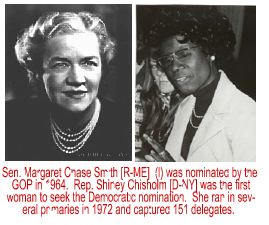 In 1964 US Senator Margaret Chase Smith [R-ME] became the first woman to have her name placed in nominattion for President by a major political party. Smith was nominated by Sen. George Aiken that year. The nomination ultimately went to Arizona Sen. Barry Goldwater who lost in the general election to President Lyndon B. Johnson.
Because women were not considered viable candidates for the office of the President, their candidacy was viewed only as evidence that the party hierarchy, whether Democrat or Republican, was solidly behind women's suffrage—particularly when the National Organization of Women [NOW] became a strong feminist advocacy voice in American politics in the 1960s. In 1984, pressured by NOW to place a woman on the ballot, Walter "Fritz" Mondale (who was running against Ronald Reagan and George H.W. Bush) selected Congresswoman  Geraldine Ferraro [D-NY] as his running mate. Although Mondale and Ferraro lost in the biggest election upset since 1820 when John Quincy Adams won only one electoral vote in his fight to win the presidency from James Madison, Ferraro has the distinction of going into the history books as the first female vice presidential nominee of a major political party. Mondale entered the history books as the man who won only his home State of Minnesota—and its 13 electoral votes—in the Election of 1984. Had Mondale won the election, a Constitutional crisis would have resulted since Ferraro could not have legally succeeded Mondale if he died in office or otherwise became incapacitated without a clarification from the US Supreme Court, or through a constitutional amendment that erases the gender distinctions in Article II, Section 1. In an interesting side note to Ferraro's candidacy in 1984, the Republicans captured 57% of all of the female votes that year. It seems that, other than the diehard party loyalists and feminists, not even the women of America wanted a woman anywhere near the White House—except, perhaps, as First Lady.
Few Americans are cognizant of the fact that an important legal question exists that has not been constitutionally addressed. The feminists believe the 19th Amendment degenderized the office of President of the United States. The evolutionary nature of the election process, combined with the belief of most Americans that, someday, a woman will become President, together with the unchallenged legal precedents when women have sought the office have, in the view of the feminists, solved the male gendered presidential issue without the need of interference from the Supreme Court, or a constitutional amendment.
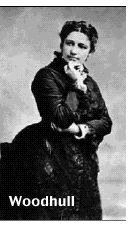 When Victoria California Claflin Woodhull announced she was seeking the office of President of the United States in the 1872, she was 34 years of age—one year less than required by the Constitution. The unflattering argument was raised that aside from the fact that Vanderbilt's mistress was too young to seek the office of the presidency, only men were eligible to run for elective federal office since the Constitution itself barred women from voting and, by extension, from holding office (thus the justification of the legal argument raised by Yale law professor Akhill Reed Amar, below), Woodhull's benefactor, Cornelius Vanderbilt, used his influence to make certain that Woodhull was allowed to run. In fact, Vanderbilt structured a bond issue to finance her campaign. The bonds would "mature" only if Woodhull was elected president—which, of course, could not happen under any circumstance since Woodhull was only 34 years old when she ran (and even moreso since her running mate was Frederick Douglas, the former slave.). Furthermore, the Woodhull-Douglas ticket was not on any ballot in any State in the union. The Equal Rights Party garnered only slightly more than 15,000 votes nationwide.
When she met Vanderbilt, Woodhull was a fortuneteller in a medicine show. As she read his palm, Vanderbilt became smitten by the sexually outspoken, gregarious woman and invited her to join him in New York. Although she was married to Dr. Canning Woodhull, the medicine show owner, she became Vanderbilt's mistress. He set Woodhull and her sister, Tennessee Claflin, up in a brokerage business, Woodhull & Claflin, on Wall Street in New York and urged his friends to do business with her.
Even though Woodhull did not meet the basic Constitutional requirements (the fact that .jpg) she was a woman notwithstanding), the precedent allowing women to vie for the office of the presidency was credibly established when Belva Lockwood ran for President in 1884. Without Woodhull's baggage, her name appeared on the ballot in several States and thus, the confusion over whether Woodhull or Lockwood was the first woman to run for President of the United States.
she was a woman notwithstanding), the precedent allowing women to vie for the office of the presidency was credibly established when Belva Lockwood ran for President in 1884. Without Woodhull's baggage, her name appeared on the ballot in several States and thus, the confusion over whether Woodhull or Lockwood was the first woman to run for President of the United States.
In any event, regardless which woman was historically construed to be the first female presidential candidate, collectively they established the legal precedent which suggests that even though the Constitution specifically defines the President of the United States as a male, women are now construed to have a legal right to seek the office of President of the United States even though it was the firm intent of the Founding Fathers to limit that high office to men..
In Article II, Section 1, the Constitution appears to establish only three ironclad qualifications for president. The president must (1) be at least 35 years old, (2) have lived in the United States at least 14 years, and (3) be a natural-born citizen. Yet, Article II, Section 1 declares that the President will be a man 16 times. Further, as noted by J.A. Corry, principal of Queen's University in London, and Henry J. Abraham, Professor of Political Science at the University of Pennsylvania, in their political science text book, Elements of Democratic Government (©1964; Oxford University Press) that in addition to the "written" qualifications for the office, there are also several "unwritten" qualifications and customary requirements that precedent has added to the qualifications for the office of President of the United States. Corry and Abraham insist these prerequisites must be viewed in the light of the entire composite. Being male is necessarily one of them.
Moreover, the Founding Fathers specifically wrote into the Constitution a male-gendered office called President. Article II, Section 1 begins: "The executive power shall be vested in a President of the United States of America. He shall hold his office during the term of four years, and with the Vice President, chosen for the same term, be elected as follows..." You really do not have to read further to realize the role of President of the United States is gender-specific. Note the qualifications for the office of Congressman found in Article I, Section 1: "The House of Representatives shall be composed of members chosen every second year by the people of the several States...No person shall be a Representative who shall not have attained the age of 25 years, and been 7 years a citizen of the United States, and who shall not, when elected, be an inhabitant of that State in which he shall be chosen..." There is no gender specification in the description of a Congressman. Nor is there any in the qualifications for Senator found in Article I, Section 2: "The Senate of the United States shall be composed of two Senators from each State chosen by the legislature thereof...No person shall be a Senator who shall have attained the age of 30 years, and been 9 years a citizen of the United States, and who shall not, when elected, be an inhabitant of that State for which he shall be chosen." Only one time, in one sentence, in Article I are the members of the House and/or Senate collectively referred to in male gender, and that is in Section 6, paragraph 2. In that instance, the usage is basically generic since there is no individual gender specific reference made for an individual person. In this single instance, the Constitution is clarifying that Congressmen and Senators may not serve a dual role in the Executive Branch of government.
Four times in Article I, Section 7 the President is referred to specifically as a man. Again, this was not an accident. The President is referred to, by gender, a total of 20 times in the Constitution. Most constitutional scholars agree that the Founding Fathers intended to establish a male gender national leader. In doing so, they explicitly barred women from ever becoming the President of the United States without first enacting a constitutional amendment that would allow them to accept the office if elected (since there appears to be nothing that bars them from seeking the office—only serving it if elected). In his book, "America's Constitution: A Guided Tour," Yale law professor Akhill Reed Amar suggests that the 19th Amendment, which gave women the right to vote, also granted them the implied corresponding right to seek the office of President of the United States. "In effect," he said, "that amendment required that the word 'he' in the original constitutional clauses dealing with the president would henceforth be read to mean 'he' or 'she.'"
Amar is, unfortunately, "reading" words or meanings not in evidence. The 19th Amendment merely grants women the right to vote. Although liberals have mastered the art of creating supra rights in existing case law by implication, there is no implied corresponding right to be construed here—particularly for women seeking the office of President of the United States which, constitutionally, is uniquely a male job. Sexist, isn't it?
Simply stated, the 19th Amendment says: "The right of citizens of the United States to vote shall not be denied or abridged by the United States or by any State on account of sex. Congress shall have the power to enforce this article by appropriate legislation." Granted, starry-eyed liberals will automatically see the expansive nature of the phrase "...shall not be...abridged..." and will expand that phrase sufficiently to drive a Mack truck through it since the entire Civil Rights Acts of 1964 and 1968 were crafted from the "commerce clause" in Article I, Section 8. But the simple truth is that all the 19th Amendment does is provide women with the right to vote in federal, State, county and local elections. While women have never been denied the right to seek public office (even when they could not vote for themselves or for other female candidates for office), there is nothing in the 19th Amendment (or any other amendment for that matter) that neutralizes the gender specific qualities required of those who become the President of the United States.
Without looking too far beyond the tip of our noses, we will find several liberal federal judges—particularly female judges—who would vehemently argue that the 19th Amendment's vote-granting to the "fair sex" tacitly degenderized all masculine references to the office of President. That argument has legal merit only if you can honestly conclude, after reading the entire document, that the Founding Fathers did not intend to create a national leader who was specifically male.
Remember, at that time there were many female monarchs in Europe, so the notion of female heads of state was not alien to their thinking. And, while the door was not closed to women seeking government office, the Founding Fathers visualized the national leader of the United States as a man—and they deliberately penned that perspective into the Constitution. If that hypothesis is correct, then a woman cannot constitutionally serve as President of the United States until a constitutional amendment is ratified to correct the presumption by the Founding Fathers that the President of the United States must be a man.
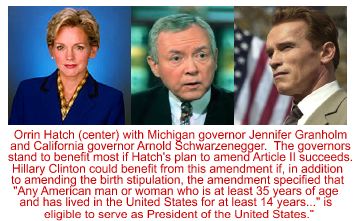 What does that mean for Sen. Hillary Clinton's aspirations to somehow become the 44th or 45th President of the United States? It means she should be thankful she has a job as the US Senator of the second most liberal State in the Union. Unless, of course, Hillary and the feminists in the House and Senate can join Sen. Orrin Hatch's [R-UT] and become cosponsors of Hatch's latest effort to weaken the Constitution. Hatch has proffered a revolutionary new constitutional amendment that will weaken the requirements needed for a candidate to run for the presidency. The latest Hatch Amendment that will trigger a constitutional amendment resolution if it is successfully attached to any piece of legislation going through Congress, seeks to eliminate the "naturally-born" clause from Article II, Section 1. That would be the perfect opportunity for the feminists to redefine the good ol' boy genderization of the office of President (while only a few people realize that the current wording does constitutionally prevent women from holding the office of President.
It is unclear why Hatch chose this time to proffer his latest amendment since it will likely benefit the Democrats far more than his own party. At this moment, Hatch's resolution would affect two high profile up-and-coming politicians. First is Gov. Jennifer Granholm [D-MI], who is the rising star of the Democratic Party. Second is Gov. Arnold Schwarzenegger [R-CA], a moderate Kennedy Republican who is, unfortunately greatly influenced by Hatch's across the aisle buddy, Uncle Teddy Kennedy. But, as I said, the person who would benefit most if an amended version of Hatch's resolution becomes a constitutional amendment will be Sen. Hillary Clinton who would suddenly not have to worry about testosterone court challenges when she announces she is a candidate for the office of President of the United States.

Copyright © 2009 Jon Christian Ryter.
All rights reserved.