
News
Behind the Headlines
Two-Cents Worth
Video of the Week
News Blurbs
Articles
Testimony
Bible Questions
Internet Articles (2015)
Internet Articles (2014)
Internet
Articles (2013)
Internet Articles (2012)
Internet Articles (2011)
Internet Articles (2010)
Internet Articles
(2009)
Internet Articles (2008)
Internet Articles (2007)
Internet Articles (2006)
Internet Articles (2005)
Internet Articles (2004)
Internet Articles (2003)
Internet Articles (2002)
Internet Articles (2001)



 nly
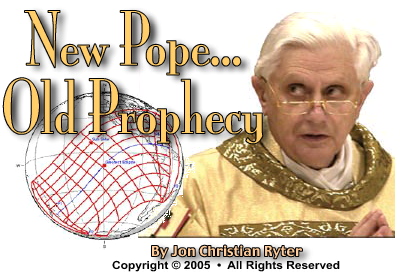
two days and four ballots into the election process to select
a new pontiff for the Roman Catholic Church, Germany's Cardinal
Joseph Ratzinger emerged as the new pontiff, taking the
name Pope Benedict XVI, and raising the specter that he
may have unwittingly—at and least partially— fulfilled
a prophecy uttered by St. Benedict (b.480-d.547AD) that
the last pope of Roman Catholic would be a Benedictine.
nly
two days and four ballots into the election process to select
a new pontiff for the Roman Catholic Church, Germany's Cardinal
Joseph Ratzinger emerged as the new pontiff, taking the
name Pope Benedict XVI, and raising the specter that he
may have unwittingly—at and least partially— fulfilled
a prophecy uttered by St. Benedict (b.480-d.547AD) that
the last pope of Roman Catholic would be a Benedictine. .jpg) While
Ratzinger was never an Olivetan monk, there is a certain
prophetic irony in the papal name he chose. A second irony may
come from St. Malachy's prophecy itself. In his prophecy,
the 12th century cardinal described the last pope by the symbol,
Glory of the Olives.
While those speculating what the term means naturally connected
olives with the olive branch—which denotes peace—and
saw the last pope as a peacemaker who would likely help bring
peace to the Middle East. A peaceful solution to the dilemma between
the Palestinians and the Jews is a precursor to Bible prophesies
concerning the endtimes. Perhaps the analogy is even more simple:
the Benedictines were Olivetan monks, and its leader, rightfully,
can be construed as the glory of the olives. Time will tell.
And time is running out.
While
Ratzinger was never an Olivetan monk, there is a certain
prophetic irony in the papal name he chose. A second irony may
come from St. Malachy's prophecy itself. In his prophecy,
the 12th century cardinal described the last pope by the symbol,
Glory of the Olives.
While those speculating what the term means naturally connected
olives with the olive branch—which denotes peace—and
saw the last pope as a peacemaker who would likely help bring
peace to the Middle East. A peaceful solution to the dilemma between
the Palestinians and the Jews is a precursor to Bible prophesies
concerning the endtimes. Perhaps the analogy is even more simple:
the Benedictines were Olivetan monks, and its leader, rightfully,
can be construed as the glory of the olives. Time will tell.
And time is running out.
With
respect to the conclave that met and selected a new pontiff in
what tied as the second fastest papal election in this century,
if popes were picked like ponies, the bookmakers favoring John
Paull II's closest friend, Cardinal Ratzinger of Germany
would have crowned him with a wreath of roses as they would the
winner of racing's Triple Crown. By the time of Pope John Paul
II's funeral on April 8, Ratzinger had 50 of the 78
votes he needed to assure his victory already in his pocket. With
only 115 eligible voters (two eligible cardinals, one from Mexico
and one from the Philippines were sick and did not come) Ratzinger,
known as the Dean of the Cardinals, still needed to pull 28 additional
ballots out of his hat to win in the opening rounds of voting
where 2/3 of the cardinals had to agree before the pontificating
of a candidate could occur. It did not seem likely, with the cultural
differences of the cardinals and the liberal or conservative personal
agendas that each of them who actively campaigned for the job
carried with them into the Sistine Chapel on April 18, that either of the two key front-runners would win since it appeared
more likely that gridlock would kill Ratzinger and Italian
Cardinal Dionigi Tettamanz's chances of winning. When Ratzinger
failed to score a first or second ballot victory, the oddsmakers
raised him from the 4-to-1 favorite to a 7-to-1 maybe.
that either of the two key front-runners would win since it appeared
more likely that gridlock would kill Ratzinger and Italian
Cardinal Dionigi Tettamanz's chances of winning. When Ratzinger
failed to score a first or second ballot victory, the oddsmakers
raised him from the 4-to-1 favorite to a 7-to-1 maybe.
Many
of the newly anointed bishops and cardinals also favored Cardinal
Angelo Sodano who greatly influenced the decisions of John
Paul II on "promotions" within the Catholic hierarchy.
Sodano played a key role in selecting all of the cardinals
appointed from 2001 until the death of his benefactor and friend,
John Paul II. Although popular with the Italian laity,
Sodano was clearly out of the running before the running
even began. He knew he would never get the nod from the conclave
because his influence died as the last breath passed from the
lips of John Paul II.  The
political cardinals in the Vatican threw their support behide
Ratzinger. Anyone who believes that Cardinal Ratzinger's
elevation was God-ordained through prayer and not politically-manipulated
by a master politician simply doesn't understand the art of campaigning
for office.
The
political cardinals in the Vatican threw their support behide
Ratzinger. Anyone who believes that Cardinal Ratzinger's
elevation was God-ordained through prayer and not politically-manipulated
by a master politician simply doesn't understand the art of campaigning
for office.
The three most influential voting blocks in the conclave were the Italians—with 20 votes, the United States—with 11 votes and the Spanish-speaking nations, which collectively had 22 votes. There were 17 votes each in North and South America, giving the western hemisphere cardinals a bloc of 34 votes. Europe has enough votes to elect a pope without the consensus of any other continent—58 votes—if ten days elapsed without naming a pope. Had that happened, very likely a compromise candidate from one of the emerging Spanish-speaking nations would have been selected.
But, in the final analysis, Cardinal Ratzinger, who had a deliberate, well-calculated plan to win the job, won the job. Reportedly Ratzinger was already campaigning for the job when the Vatican announced that the death of John Paul II was imminent. Ratzinger really wanted to be the pontiff (unlike hsi friend, Polish Cardinal Karol Wojtkyla who not only did not campaign for the job—but was surprised when he got it).
As the Conclave of Cardinals met on Monday, April 18, 2005 to select the replacement for Pope John Paul II, few people in the world were aware that the bizarre hybrid eclipse witnessed by millions of people around the world on April 8, 2005 was prophesied by a Catholic cardinal in 1140 AD specifically as a sign for that pontiff. Pope John Paul II was described by 12th century Roman Catholic Cardinal Malachy as "De Lobaore solis" (Of the eclipse of the sun).
The Malachy Prophecy, penned by Cardinal Malachy while on his way to Rome for the coronation of Innocent II, described by symbol, the papal succession from Celestine II (the pope would succeed Innocent II) to the end of the world. Interestingly, on the day of his birth, a solar eclipse occurred that was visible over Poland—the nation of Karol Wojtkyla—the man who become pontiff of the Roman Catholic Church.
By the time of John Paul II's death, the Malachy Prophecy has proven to be 98% accurate. Whether or not it proves to be 100% accurate will depend on whether or not any other pontiffs follow the pope who was symbolically described as Gloria Olivae (the glory of the olives)—and whether the events known as the Rapure and the Tribulation commence during the reign of Pope Benedict XVI.
When
the description of this uncommon hybrid type of eclipse appeared
in the article The
Malachy Prophecy on my website scant hours before the
eclipse began to appear, the site received scores of emails from
readers poophahing the notion that an eclipse alternating from
a partial to a total eclipse would circumvent the globe. While
anular eclipses are a rare phenomenon, they are not unknown. 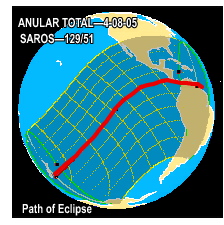 The
April 8 hybrid eclipse was visible from within an angular corridor
that was predominantly visible from the southern hemisphere. The
total eclipse, which began southeast of New Zealand traveling
on a narrow band 28 kilometers wide quickly narrowed to a sliver
within the first 13 minutes of its journey past of Tahiti on its
way to Pitcairn Island. It continued on a northeastern course
as it crossed the Pacific Ocean to Panama, Columbia and Venezuela.
(One of the photos, above, was taken on Pitcairn Island). The
moon's penumbral shadow cast a wide swath across half of the planet,
covering all of New Zealand, Australia, the South Pacific islands
and much of South and North America from southern California on
the west coast to New Jersey on the east coast. Over a period
of 3 hours and 24 minutes, the eclipse traveled 14,200 kilometers.
The
April 8 hybrid eclipse was visible from within an angular corridor
that was predominantly visible from the southern hemisphere. The
total eclipse, which began southeast of New Zealand traveling
on a narrow band 28 kilometers wide quickly narrowed to a sliver
within the first 13 minutes of its journey past of Tahiti on its
way to Pitcairn Island. It continued on a northeastern course
as it crossed the Pacific Ocean to Panama, Columbia and Venezuela.
(One of the photos, above, was taken on Pitcairn Island). The
moon's penumbral shadow cast a wide swath across half of the planet,
covering all of New Zealand, Australia, the South Pacific islands
and much of South and North America from southern California on
the west coast to New Jersey on the east coast. Over a period
of 3 hours and 24 minutes, the eclipse traveled 14,200 kilometers.
The first recorded annular eclipse (a hybrid that switches from a total to a partial eclipse and back again) occurred on May 6, 1464—30 years before Christopher Columbus set sail on a journey that would bring him to the New World. The next hybrid eclipse will occur on April 20, 2023.

Copyright © 2009 Jon Christian Ryter.
All rights reserved.